Danil Kasputra
Perhaps historians, tourists, readers have long perceived that Indonesia tourism rooted to the twentieth-century colonial tourism. Most of them still refers to the concept of free time as one of the basic requirement for the development of tourism and point out that the middle of nineteenth century is the most apprioate time to consider the emergence of tourism as a modern-day phenomenon (2014:100). In the fact, it a was a full questioned perception. No one account that tourists did not exist back in the ancient times (2014:99). Much evidences of travels was made for various reasons and motives such as Trading, power, etc. But due to the tourism term just was born when leisure developed in the capatilsm-era, so that lthe special-purpose travel was the precise name to mention this activities.
The special-purpose travel in the ancient Indonesia are the subject of this article. In first part I displayed how trade related travels as one of the special porpuse travel (old-tourism) activities in ancient Indonesia times. In the second part of this paper, I explains concern the travel made for a power. In fact, beside both example still were many special purpose-travel that made by Indonesian in the ancient times. But i was more focused to those two type based my own source.
Travel for a trade
Of the travelers that wrote its early name in the realms of Indonesia history, none is more old and important than merchants. As ancient greek merchants, Indonesia merchants were also the first who left or their own will (2014:100). Commercial motive was main motive with sea routes as a favorite for the safety and fluecny.

Picture 1. Indonesian maritimes boats had travelled and sailed through sea less or more a millenium ago. (The images was an old-relief of magnificent Borobudur temples dates around the IX century).
The earlier evindence of Indonesia merchants travel was beautifully carved on a old-exotic maritime boats relief of Borobudur temples that dates back around the 9-th century (1992:200). Unfortunately, no one knows how far ancient Indonesia had sailed. The remained evidences was a few that was on the hand. However, at least, we knows that around a millenium ago, ancestor had travelled and seemly taken part in the international-comercila traffic. As Herman Burger (2011:1) storied in his work De Garoeda en De Ooievar that “…..waren er ook zeevart en handel een belangrijke inkomsten vormden. In de loop van de eeuwen ontwikkelde zich een levendig handelsverkeer, zowel binnen de archipel als met andere delen van Azie, zoals China, India en Perzie…. “
From the Portugues, far in the early of the sixteenth century, the tight veil of darkness how far the Indonesian travel little by little opened. Summa Oriental, one of monumental work written by a Portuguese apothecary, Tome Pires (1990:50) that reported us that there is much Indonesia merchants in the Portuguese occupied port of Malacca, “…….men of Tanjompura, Laue, Banka, Linga, Moluccas, Banda, Timor, Madura, Java, Sunda, Palembang, Jambi, Tongkal, Indrangiri, Kapatta, Menangkabau, Siak, Arqua, Aru, Bata, country of Tomjano, Pase, Pedir, Maldives… “.
In the Pires’s Account formed a clue : first, the existence of Indonesian in the Portueguse malacca port, gives us a impression that Indonesian merchants in the sixteenth centuries had travelled and accrossed sea as far as Malacca. The second, a wonderful impression appeared concerned the Indonesia merchant’s travel that made them taken part in global trading-traffic in the sixteenth century.
In the same time, river’s route enjoyed a great advantage. Their was well deserved a intermediatery between crowded and advance coastal Javanese area and mysterious Javanese hinterland. Merchants of the 15th century would like to travel by the route. Demak in the early of fifteenth century, a rich capital and harbor of Demak Dynasty was a most representative example about how river played a dominant role in traffics of goods and merchants (1974:35).
Travel for a power
It is a commonplace that as early as times Indonesia made a travel for the search of a power. We found in Babad Tanah Jawi, a book of javanese-kings chronic that appeared in the early of the seventeenth century that there are two purpose how then the travel made. The first was to search a new territory for the building of a new kingdom of Dynasty. This is represented by the legendary story of Raden Fatah. Meanwhile, in the second place, was the purpose for a legistimation of power. The full-legendary and myhtical travel of the Islamic-Mataram ruler, Panembahan Senapati represented this.
According to Babad Tanah Jawi, after years his service on a pious muslim saint or wali, Sunan Ampel, the legendary Demak ruler, Panembahan Jin Bun or Raden Fatah before he rise on the throne. He married a dochter of the saint and set out towards the west to find a place that had the fragrant ground. The saint forecast that there the future-Dynasty of the price would be built, “Sesusah menikah, Raden Patah disarankan oleh Sunan Ampel untuk berjalan ke arah barat dan mencari tempat yang beraroma harum. Tempat beraroma harum itu bernama hutan bintara. Kelak hutan bintara itu akan menjadi kerajaan bernama Kasultanan Demak Bintara” (2013:72).
On one side, this story suggests us that the travel purely was made for the purpose of building for a new territory, without a friction or conflict, whole seemed the peace. However, on other side, seen from the context of the 15th century, this travel reflected a struggle over the competence and power, more than filling a purpose to build a new land. Majapahit as the patron of Hindu-Budhist culture still existed. Although the Dynasty was on the critism when its subjects were especially the Northern-coastal rulers separates and converted to the Islam. Therefore, a conclusion appeared that the order of Sunan Ampel to Raden Fatah for the search of a new land was to build a land that in the future able to competence the old Majapahit. It was prove with events that occured in the later years.
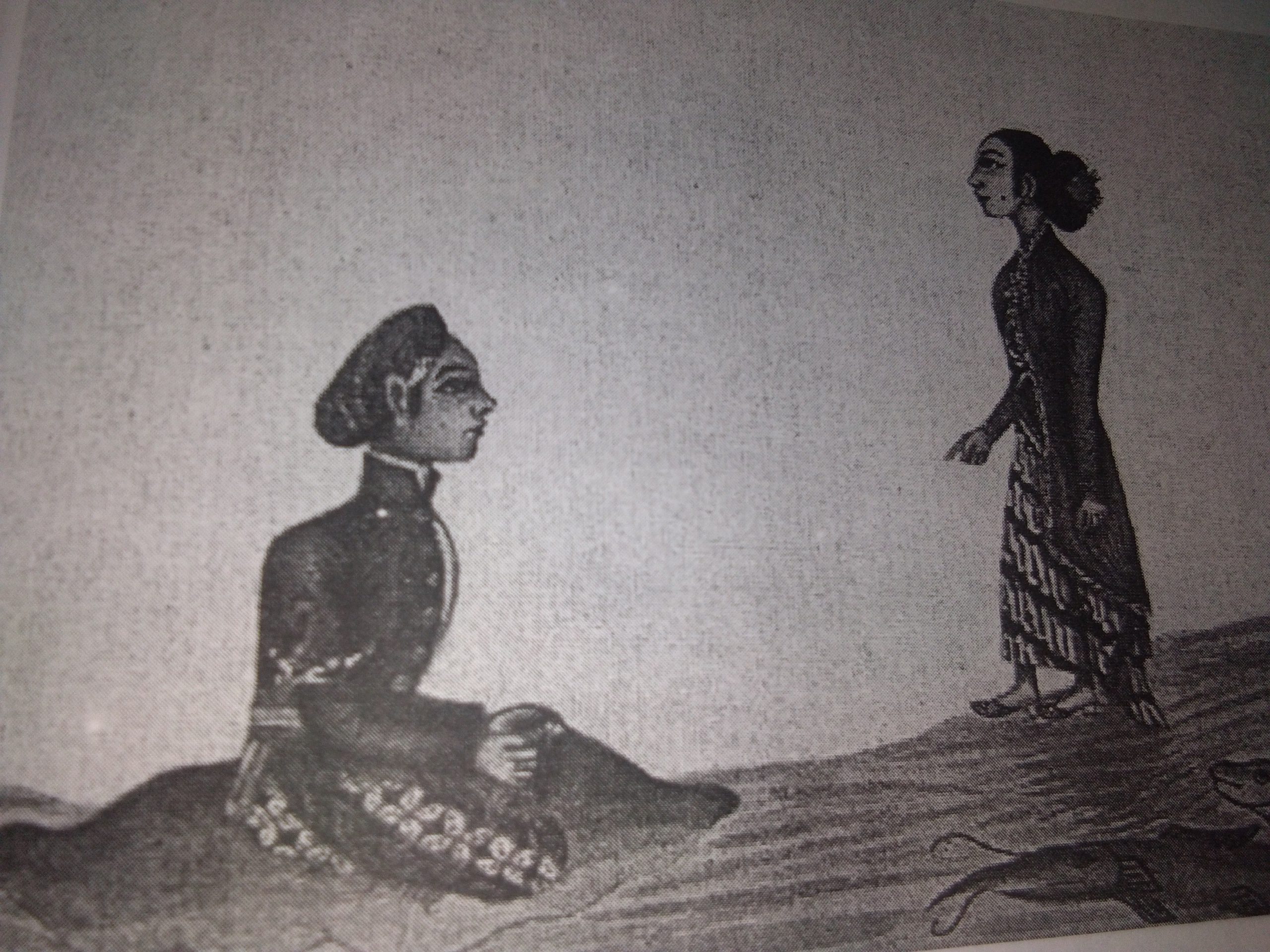
Meanwhile, in the second place was a purpose that reflected the travel for a legistimation of power. The story of myhtical travel of an Islamic-Mataram Dynasty ruler, panembahan Senopate in the middle of the sixteenth century represented this model. Babad Tanah Jawi told us that Senopati Ingalaga as he was callled in that book, and also the an ancestors of today Yogyakarta and Surakarta kings travelled to Parangtritis in the south of modern-day Yogyakarta. On top a holy rocky, he meditated and received a spiritual vision that was pictured by a beautiful goddess in the Javanese paints. Javenese tradition remembered an encounter Senapati with a Northern-ocean ruler, Kanjeng Ratu Kidu. The detailed description of his travel written this below,
“…Dari Lipura, Senapati Ngalaga mendaki gunung Merapi. Dari Gunung Merapi, Senapati Ngalaga berjalan sendirian ke arah timur. Mencebur ke sungai Umpak (Opak). Melakukan tapa ngeli menuju tempuran Samudra Kidul. Di sungai itu, Senapati Ngalaga bertemu dengan naga Tunggulwulung. Melalui naga itu, Senapati dapat bertemu dengan penguasa Samudra Kidul. Sang Ratu Kidul yang menguasai para penguasa (raja) mahluk halus dari Gunung Merapi, Lodhaya, Kare, Waringinuwok, gunung Agung, gunung Prahu, Prabu, Dalepih, Kuwu, Baledhung, Kayulandheyan, Ngalrawalobang, Karang, Panaruban, Kabareyan, Gunung Lawu, serta Rawa Pening” (2013:118).
Picture 2. Less or more five hunreds years ago, initiated by their ancestors, Panembahan Senopati. Islamic-Mataram kings made an annual fullfilled-mythical travel towards the Southern-coast. ( The images displayed an invisible encounter between a legendary ruler of Islamic-Mataram Dynasty, Panembahan Senopati and Southern-ocean goddess, Kanjeng Ratu Kidul in a Javanese pain).
History and myth are often wonderfully interwinted. Although the travel of senopati was fulfilled a doubt with the myhtical flavors of the story. However, no one disproved that his travel to the northern coast was a true story. Even his descent followed his action and considered its an annual tradition of kingdom. Sultan Agung, Amangkurat I up to Diponegoro, a Yogyakarta prince in the nineteenth century that was considered as the repsentation of pious muslim prince, also made a annual travel to the Southern-Coastal.
Concerned an encounter the king with the Southern Ocean ruler, Kanjeng Ratu Kidul. It seemly was a created intentionaly myth as a legistimation for the power. Kanjeng Ratu Kidung symbolised his loyalty of whole southern-ocean under Senopati as mentioned in the availaibility of Kanjeng Ratu to give his the help for the continuity of Senopati’s kingdom that in the same time was competing with the rich and proper Northern-coastal kingdoms such as Surabaya, Gresik, Tuban, etc. After from the competence with Northern coastal rulers, Senopati still continued to defend the new kingdom from raids of his ex-employer, Sultan Pajang.
Conclusion
What is described above seems to be an affirmation that the old-tourism or the special-purpose travel is multifaceted. There are many factors which contribute to the way different people define the special-purpose travel. Trading and power play a role in the stimulation of ancient Indonesia to travel that it becomes one of basis for the rise of Indonesia tourism in the future-years.
Daftar Pustaka
Hannigan, Tim. A Brief History of Indonesia. Jakarta. 2015
Achmad, Sri Wintala. Babad Tanah Jawa. Jogjakarta. 2013
Burger, Herman. De Garoeda en De Ooievar. Leiden. 2011
Cortesao, Armando. The Summa Oriental of Tome Pires and The Book of Francisco Rodrigues. 1994
De Graaf and Pigeaud. De Eerste Moslimse Vorstendommen op Java. Gravenhage. 1974
Rubotic, Branislav. Special-Purpose Travel in Ancient Times:”Tourism” before Tourism. Belgrade. 2014.
История Индонезии. 1992
Leave a Reply