Rendy Kurniawan
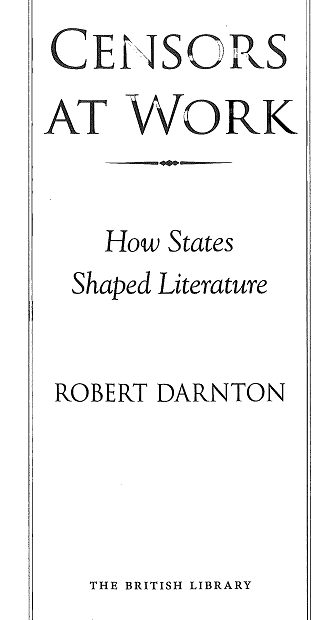
The term “censor” has no acceptable definition throughout the history. Periodically, the meaning of “censor” sometimes different and debatable. Because of this fact, indeed there is no exact answer about what is censor. Rather than confused defining censors, Darnton with his work tried to figure it out differently. Three distinctive cases of literature suppression in France in Eighteenth century, India in Colonial reign and East German under the hand of Communism are being the concern of this book. In turn, these comparative study might help the readers to find out what is censorship and its history.
The kingdom possessed the censor of early Eighteenth century France. In the other words, the court seized the control over literature distribution. There is no editor nor bookseller except the royal representatives. At least, this might be occurred until the French Revolution in the end of Eighteenth centuries. The whole story went extremely different in the India under the British reign. In this different place, nineteenth century was an important period over India censhorship history. Generally, British Government had no censor institution to restrict any book or document.
However, the state would impose certain law whenever it felt threatened by this ‘freedom of speech’. For instance, James Long of Bengal who write ethnographic study was imprisoned because of his work. It suspected to be an insult to the british rule over India. Move toward the heart of Europe in different time, East German under the Communism had unbelievable censorship.
In investigating the East German, Darnton was able to meet the person in charge. He met a man and a woman which is worked for Communist in East German. Compared with France and India before, The censor of East German is quite different. Rather than limiting and restricting the censor of East German is planning the whole literature. It means that, the state arranged the published literature. Darnton had found the annual list of East German’s planned literature. In this case, the state hardly intervened with the literature publication.
From the observation of three distinctive cases, thanks to Darnton, people might be concerned about what is censor and its history. In addition, From this comparative study, there is a critical point. Censor had and may still have a strong connection to the state intervention. Eighteenth century France, Nineteenth Century India and Twentieth Century East German was a notable example over this statement.
Lihat juga :https://tareekh.my.id/2020/09/14/mukhtasar-al-mufid-fi-ilmi-tarikh/
Lihat juga : https://en.wikipedia.org/wiki/Robert_Darnton
Leave a Reply