
By: Danil Kasputra
The emerging of Bandoeng Vooruit in 1925 marked a turning point in the development of natural tourism in Bandung, for it provided a modern tourism management by building of road, hotel, promotion, etc. As result, it was during the period from 1925 to 1942 Bandung enjoyed prestige as one of most important destination in the colonial Netherlands Indies Empire, when thousands of Europeans Japanese and Australians tourists flown heavily to spend them days in the foggy and green mountains.
This article examines the development of natural Tourism in Bandung from 1925 until 1942 following the collapse of the colonial Netherland Indies Empire in 1942. When Dai Nippon troops marched into Bandung, the center of empire, it was ending three hundreds and fifth years the horrible Dutch occupation. To understand how the natural tourism in Bandung rose and developed. We will explore these questions: (1) What Visiting Before Tourism gave a root on tourism, and what consequence came of its for the advance of Bandung natural tourism in tomorrow days? (2) How did the development of natural tourism in Bandung as long as seventeen years from 1925-1942?
Visiting Before Tourism
West Java, before twentieth century, was unimaginable area due to its unaccessible. It was occurred because of its own mountains and hills mounted between limpid rivers as well as black swamps to separate the region from outside world. No wonder, the name Priangan was attributed which refers to remote and mountainous lands. Besides, the southern lands of Priangan almost uninhabited. According to one interpretation, the lands in the region had become wild and uninhabited. This recalled the social disruption following the fall and eventual destruction of the pre-colonial Hindu state of Pajajaran.[1]
But in the end of sixteenth centuries, the world of West Java gradually changed in consequence of foreigner expeditions. It was a starting point in the natural tourism. And The Portuguese was pioneer. Although for next centuries, Dutch take control them role and it played important role in performance. The first adventurer of Portuguese visiting West Java was Joao de Barros In 1522. When he took part in a Portuguese Expedition under Henrique Leme sent by Jorge de Albuquerque, “Kapitan Malaca” for commercial. Expedition had succeeded to reach Sunda which was welcomed by Samiam, the King of Sunda.[2] When the fleet was at anchor in the port of Sunda. Barros immediately adventured to explor the part of North Coast of West Java. In adventure, Barros zealously made the narration of West Java condition including custom, geographies, society, etc,
Yet, Barros explored the part of North Coast of West Java and he hardly ever visited the interior of hilliness and mountainous West Java. After the advent of Barros, there were many Portuguese landed in West Java. But same as Barros, they preferred to explore the Northern Coast of West Java. However, for centuries the Southern part of West Java was still an unimaginable and forgotten area.
In 1677 when Mataram as the ruler of West Java was more and more weak, the region was transferred to VOC. But this did not changed condition. West Java only that the Nothern Coast of West Java was still considered to be unavailable. Apparently, Dutch designedly forgot the region. For the lack of initiative knew to be further. Dutch only made the region as buffer state between two great power, the Sultanate of Banten which was still courageous on Western and on Eastern, the Sultanate of Mataram was more and more become old. But when Batavia was more and more stuffy, VOC began looking the interior of West Java as a solution. Some of Expeditions was sent. The first expedition was begun when Francois Valentijn, a VOC priest visited the interior of West Java. That was the early visit of Europeans to the interior of West Java. For years later, Valentijn narrated him experience by a book, Oud en Nieuw Oost-Indien in 1724.[4] Stories of Valentijn many described the statistic populations and geographical condition of West Java Interior. In narration, Valentijn phrased dessa dessa laid on Krawang river.
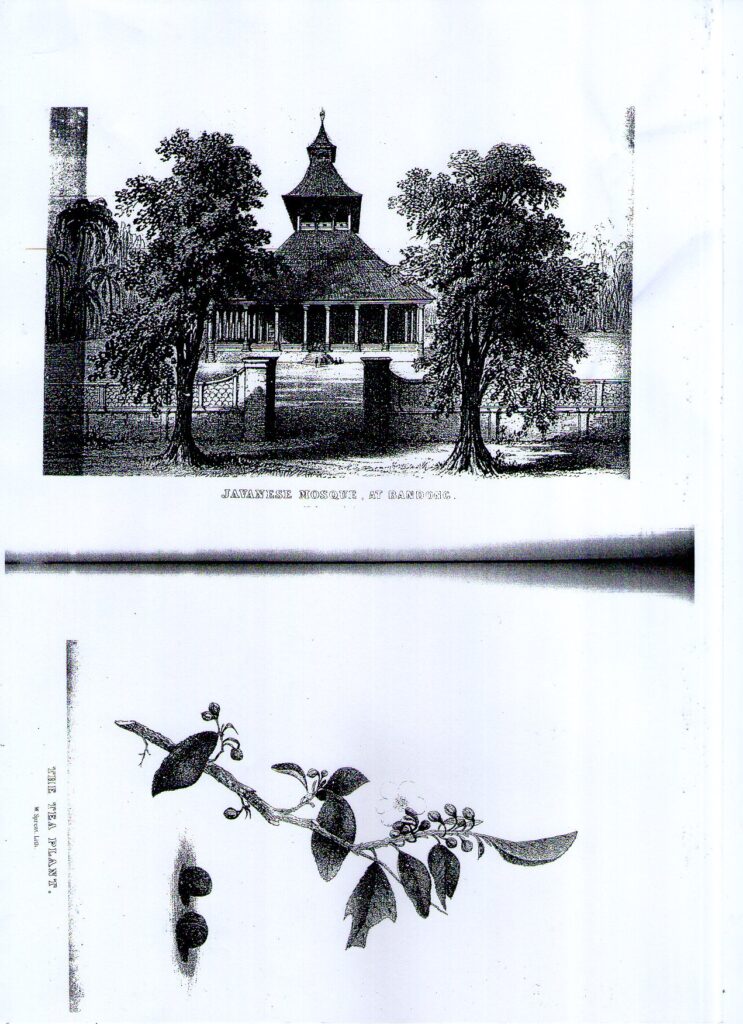
One hundred years after the adventure of Valentijn, the other illustrations of West Java interior, we found from the story of Charles Walter Kinloch or Bengal Civialian, a British visiting interior of West Java in 1852.[5] Kinloch narrated playfully him experience day in day out for ten days which made him narration to be more attractive than the predecessor, Valentijn who rigid. Kinloch described that Bandung was a beautiful place although it was not as wide as Cianjur. Its cold air and climate remembered him on the city of Montpelier in France. Kinloch enjoyed him travel. In visited places, he made lithographies which was one of Masjid Agung Bandung lithography. Kinloch wrote all of it with so delighting. Yet sometimes he was forget to call visited place names so that reader was ever so often made to be confused. Though him description was so detail. As example, the description about waterfall in Bandung,
The Birth of Bandoeng Vooruit
The adventurism narrations of Barros, Valentijn, and Kinloch had changed wild and frighten shadow of West Java interior replaced by a wonderful imagination of exotic West Java interior. Its beautiful lakes, green and foggy mountains and hills, and limpid rivers were presented in their narration. Interested by those exotic narration, since the late nineteenth centuries thousands of Europeans flooded the West Java interior. They tried to prove the truth of Barros, Valentijn, Kinloch, by created myths. For the region, those floods of Europeans was extremely beneficial. And as if those benefits was more and more beneficial, when the railway, the Groote Post Weg, and telegraph network was built in the end of nineteenth centuries. As time passes, those floods of Europeans was more and more uncontrollable. This brought upon a problem. In 1925, a group of Dutch took an initiative by the building of tourism managing organization, Bandoeng Vooruit.
Started with this birth of Bandoeng Vooruit, West Java interior in particular Bandoeng changed from the remote and wild area towards the most modern tourism area of Netherlands Indies. His birth became a limit line between visiting before tourism and the activity of modern tourism. Made no to magnify the role of Bandoeng Voouit, other organizations also played role in tourisme activities although them activities was not as large as Bandoeng Vooruit.
To manage tourism activities, tens of tourism packets to West Java interior was presented by Bandoeng Voouit. And the tourism packet of Gunung Tangkuban Perahu dan Gunung Papadayan was favorite. Coincide with the offers of tourism packets, the picture of limpid Patenggang lakes, cool Citarum rivers, Burangrang green mountains, the sound of Dago waterfalls as well as Manglayang foggy hills was published in the tourism guide and tourism magazine. To give a comfort for tourist, all of those tourism spot was equipped with ways of being covered with asphalt, and comfortable hotels. As the consequence of it, the story of West Java wild and frightening interior was barely heard. On the contrary in that time, its natural beautifulness and coolness was many mentioned.
The activities of modern tourism 1925 – 1942
Promotions
To be so lucky for West Java, Bandung Vooruit was exactly established when West Java in particular Bandung was bed of down for Europeans. Its pleasantness was not only as a settlement but also as a promising tourism destination. For some of people, this was absolutely a beneficial business. Pioneered with the tourism guide book, Ons Java published by Nederland en Rotterdamsche Llyod in 1920s, tens of tourism guide book were on the scene. Bandoeng The Mountain City of Netherlands Indies (1925), Gids van Bandoeng en Midden Priangan, Gids van Bandoeng en Midden Priangan (1925), Tourist Notes (1934).
From week to week until year to year, West Java with its foggy and green mountains reaching into sky as well as the sound of waterfall cleaving the solitude and limpid lakes embellished with water lilies colored page by page those tourism guide books. No different with performed pictures, created narrations was written to be truly wonderful. When reader had dissolved in those hammock of narrations, narration will bring readers on a curious feeling. As a proof from Bandoeng The Mountain City of Netherlands Indies we take example about a description of Citarik Waterfall,
A very beautiful waterfall which can be reached entirely by motor car is that of the Tjitarik. This is reached by driving to Tjilengka for which one hour is necessary. On arriving at the aloon aloon one turns left after which the road climbs steadily until the tea estate “Sindangswangi” is reached. After having driven for half an hour an before reachs this estate, a shelter is to be seen from where a beautiful view of the waterfall can be obtained. It is here also possible to descend to the foot of the fal[7]l
When tourism guide books offered a promising business, on the contrary, the government looked on the other opportunity. Pulled by the increasing demand of post card, it stimulated the government on a creative promotion. That creative promotion tried to perform the nature of fascinating West Java as the background of post card, where dense mountains and beautiful lakes still become the primadona. No wonder, at short notice, the thousands of post cards had published in 1930.[8]
Accomodations
Stimulated by promotions succeesly to interest the visit of tourist to West Java. Hundreds of accomodation spots immediately was built scattering around tourism natural spots in the green and foggy Priangan Plateau. Those accomodations included extravagant, comfortable, and fascinating hotels and Pesanggrahans that laid on the limpid watering lakes. At end of nineteenth centuries until the early of twentieth centuries, when a smell of intoxicating sulphur on the side of legendary Kawah Putih and a bulk of up-side down boat resembling high and fertile soil which was named Gunung Tangkuban Parahu by Sundanese, was so interesting for Europeans, the number of hotels quickly increased as fast as the advance of this plateau.
At heart of Daendels dreamed city and exactly on side of muddy river of Citarum as well as stood before legendary way of Groote Post-Weg, Savoy Homan and Preanger was existed. Until mid-twentieth centuries, both hotels take possession of first rank hotels in colonial Netherlands-Indies Empire. It provided modern, extraordinary and luxurious service. When Europeans flooded the plateau of cold Bandung, both hotels was wrested by them.[9] Not far from classic Savoy Homanan and Preangers hotel laid on around the heart of Bandung, there were Wihelmina, Societiet Concordia, and Du Pavillon. They were middles-class hotels pale beside with Homann and Preanger.[10]
No different with Savoy Homann and Preanger in luxury and comfort, Villa Isola performed itself as most luxurious and modern hotel in this area. When whole side of Bandung were still as dark as the other interior, the light of blazing lamps of musical performance as well as ball room dance and the musical performance able to bright those darkness. Unsuspected by those light of lamps, a hundred of American tourist visited it.[11] Meanwhile laid on the plateau of cold and white foggy Lembang, outspread along the road toward the harmoniously Tangkuban Perahu, Hotels, Bungalows, and Passanggrahan that providing a sight of beautiful and green mountain was fragmented there.[12]
Not left behind Dutch comfortable and luxurious Hotels, Chinese communities built a dozen of hotels scattered across the hot and musty Pasar Baru, dusty Kebon Jati until the curve rising road of Gardu Jati. At least there are 22 chinese hotels. It was not as luxurious as and as comfortable as than Europeans hotel. But can be proud that their hotels able to compete with luxurious Europeans hotel.
The Place of Tourism
The century since Kinloch had made his notes, the natural tourism of Bandung had interested the attention of heterogeneous European. The unique and exotic form of green Tangkubang Perahu and the side of engagingly and limpid Patennggang Talaga had been legendary in the European eye. Yet those attention was immediately disappeared when the steep and rock slopes of hills and mountain, black swamps, and horrible dense forest scattered along the Priangan plateau. Unimaginable previously in the future this horrible area would be fated to be one of foremost natural tourism destination in the colonial Netherlands Indies Empire. In the mid-second decade of twentieth centuries, the story changed as dramatic as a telenovela cinema. Preceded by the build of Bandoeng Vooruit by beautiful Tangkuban Perahu toward road means, Natural Tourism objects experienced a golden age where era will never come back in tomorrow days.
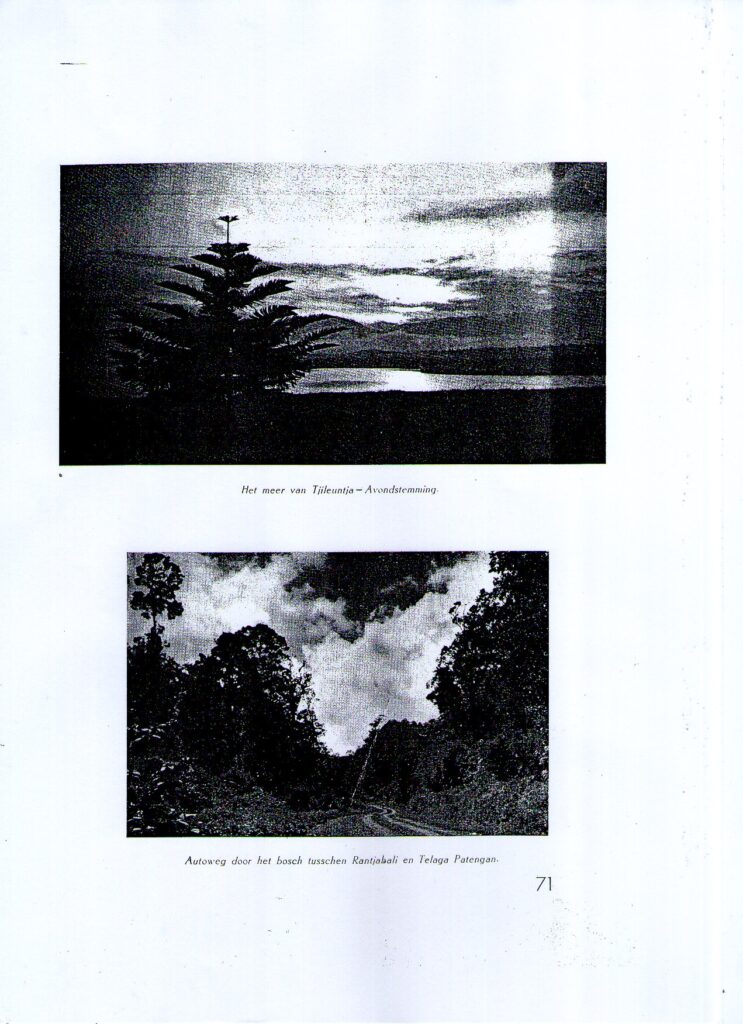
With a horde of limpid and quiet lakes, as well as a range of green and white foggy hills and mountains together with the hot and steaming craters, the South Bandung provided an eye cooling sight. There were kawah putih with a smell of intoxicating sulphur which was residing a white ghost of tiger in native legends. As beautiful as Kawah Putih more or less 50 km from the heart of mountainous city, Bandung, slipped between the green carpet of tea plantation, Talaga Pategang performed shown face before the Ciwidey muddy road. Not far away from it, a bulk of old mount Patuha, stand on the height of less 1500 meter above the sea level.
Not different with the Southern Bandung area, a range of unique and fabulous mountain interacted each other. Lead by the mysterious mount of Tangkuban Perahu, Burangrang mount, Dago hill followed behind. Inadequate with those mysterious mounts, the sound Curug Layung of water flew in a small stream to be very interesting for tourist or adventurer. Additionally exact below it, warming up and cooling down, the bathing place of Tjipanas provided a warming place in the cold mountainous air.
In the end of Eastern Bandung not as interesting as Southern Bandung and Northern Bandung, stretching along the legendary “Groote Post Weg” and standing before the old Sumedang and exotic Garut, the old and short hill of Manglayang was a pleasing place for ascent. Even as long as 1936, its peak was ascended by tourist hundreds.[13]
Close resemblance as exotic as natural tourism spots of Southern and Nothern Bandung, scattered along the dusty limestone and laid before the Daendels dreamed road, Groote-Postweg, the Western Bandung was still as beautiful as when Kinloch had been visited 75 years ago. There are the landscape of remote and hilly Curug Malela in the wild Gunung Halu interior. It was rounded by the green and fragrant tea plantation. In same area as far west as from Curug Malela, less than 1 km from De Groote Postweg, hidden between mysterious caves, here Sanghyang Tikoro slipped. Legends mentioned that this was point where the old bandung lakes broken down since less than thousands years ago.
Tourists
They had sighted the city when they were still far out at road. A green stain stretching out across the horizon of the Priangan Plateau. Over the course of the morning, a range of mountains rearing inland under banks of creamy cloud, and a strip of slope under an infinite rank of larch. Eventually, the train entered into railway station. As the tourists reached down from wagon and embarked on the first travel after a day at train. One of tourists looked out on the scene, noting its detail in his formidable memory. He was M Mcmilan, a Britania Tourist.[14]
By the time before the M Mcmilan arrival the Bandung had interested attention since the early nineteenth century. Forged of a strip of European done visits and adventures, it had swiftly been known by strange tourists. Year by year, they spilled out from its Australian, European, and Japanese wellspring, flooding the Tangkuban Perahu mount and the Talaga Patengan, seeping up into the Curug Malela, leaching across Papandayan Mount.
Its peak in the period of 1925 until 1942, when thousands men had come lumbering the hilly and mountainous Bandung from the multi-ethnic backgrounds included the Japanese who slant eyed, blue eyed and high postured Europeans, the mixed race Indo-Europeans until a number of native aristocrats.
Conclusion
Started by the curiosity about a mysterious land stretching from west to east, laid behind the old and tropical Batavia, and well walled firmly by a range of foggy and creamy clouding mountain and hills, and its below flowing swiftly as swiftly as cobble stone following it, tens adventurer bravely penetrated into the land. They did not realized that their adventure would bring on a great consequence in tomorrow. When legendary stories able to change that mysterious land into one of foremost natural tourism destination in the colonial Netherlands Indies empire. Undoubtedly even more important was the stories of natural tourism spot discovery that wild, unhabitated, and horrific Bandung immediately was replaced by its limpid rivers and lakes as well as exotic craters. Soon after those legendary stories swiftly spilled out from its Bandung wellspring, filling the Dutch and other Europeans mind, seeping up into Japanese ears, leaching across into American, finally, Bandung was flooded by foreign tourist coming as fast as those legendary stories into their ears.
By the dawn of the early twentieth Bandung was undergoing a formidable change in complexion, when a group Dutch created one of the most influential organization in the History of Netherlands Indies, Bandoeng Vooruit. Natural tourism spot from Bandung had been finding their way into one of main tourism destination in colony or the world. Pulled by extended promotions as well as hotels, and passanggrahan that scattered between beautiful tourism spots along with the flooding visits, within a decade since Bandoeng Vooruit establishment in 1925, Bandung had been set up as a modest destination of tourism.
[1] Jan Breman. Mobilizing Labour for the Global Coffe Market Profits From an Unfree Work Regime in Colonial Java. (Amsterdam: Amsterdam University Press, 2015). hlm. 17
[2] Claude Guillot. Sejarah dan Peradaban Abad X – XVII. (Jakarta:KPG, 2008). hlm. 32
[3] Joao de Barros. Da Asia De Joao De Barros Dos Feitos, Que Os Portuguezes Fizeram No Descubrimento, E Conquista Dos Mares, E Terras Do Oriente, Decada Quarta, Parte Primeira. (Lisboa: Na Regia Officina Typografica, 1527). hlm. 77
[4] Francois Valentijn. Beschrijving van Groot Java Of Te Java Major. Vierde Deel. (Amsterdam:Joannes van Braam, 1724). hlm. 9
[5] Ahmad Sunjayadi, Vereeniging Touristen Verkeer, (Jakarta:FIB UI, 2007), hlm. 5
[6]Charles Walter Kinloch, Rambles in Java and The Straits in 1852, (Malaysia:Peter Chong Printers). hlm. 58.
[7] Reitsma, Bandoeng The Mountain City of Netherlands Indies, (Batavia:G.Kolff & Co, 1925), hlm. 44Reitsma en Hooglands, De Gids Bandoeng en Midden Priangan, (Bandoeng:N.V Mij Vorkink), hlm.


Leave a Reply